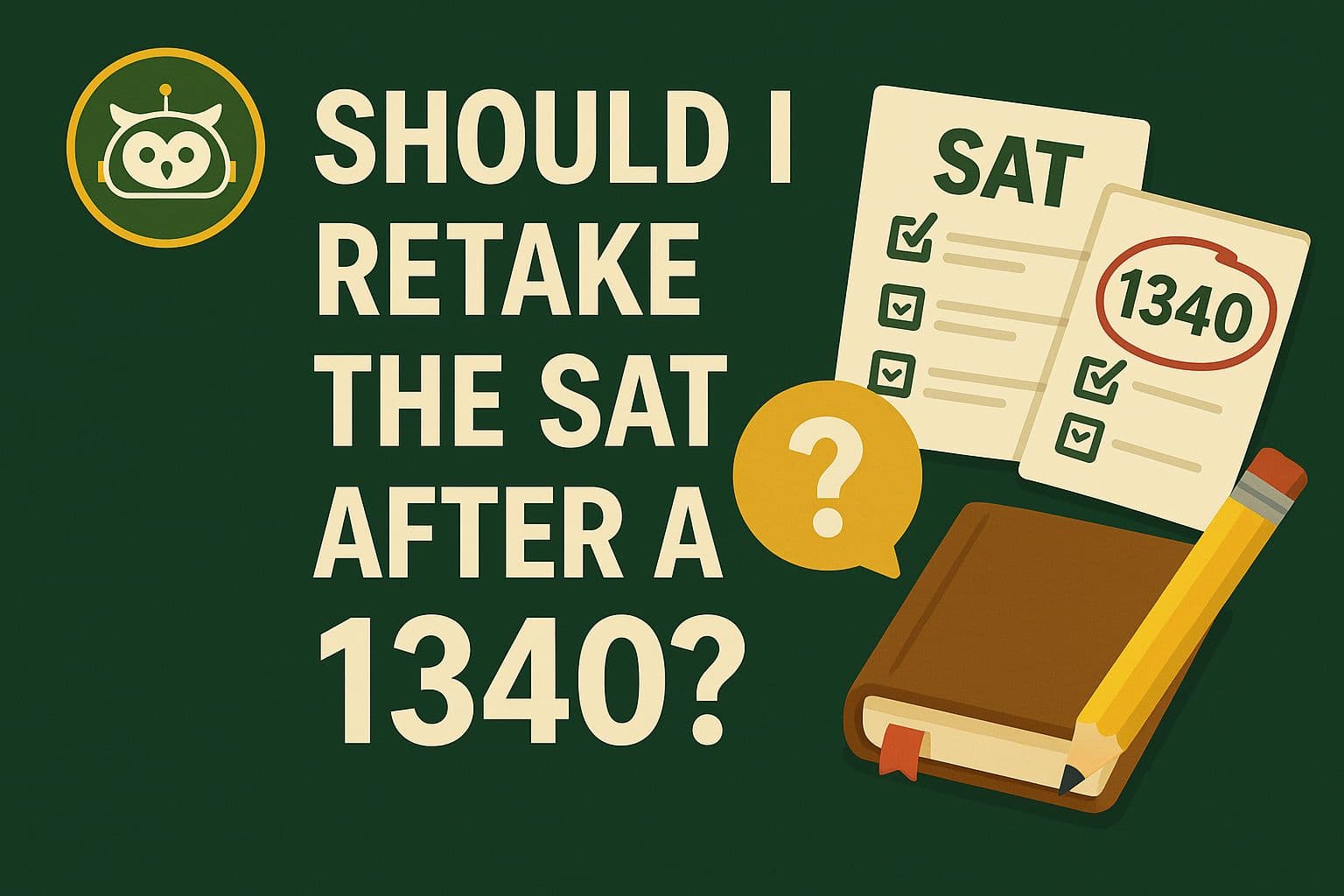
A 1340 SAT sits in the 90th percentile — competitive at most state flagships, but below the 75th-percentile cutoff at top-50 universities (typically 1450+). Whether to retake depends on three factors: your target schools' median SAT, time before application deadlines (4–6 weeks of focused prep can add 50–100 points), and a section-level diagnosis of which math or reading-writing categories drove the score. Most 1340 scorers should retake if their target schools' median SAT exceeds 1400.
Work out your own score: enter your correct answers per module in our SAT score calculator — it converts them to a 400–1600 score and shows your percentile among SAT takers.
A 1340 SAT score places you in the 90th percentile nationally, making it a strong score for many colleges. However, whether you should retake the SAT depends on your goals. Here’s a quick breakdown:
Key Considerations:
- College Admissions: A 1340 meets the lower range for competitive schools like the University of Michigan and UNC Chapel Hill but might benefit from a slight boost for top-tier schools.
- Scholarships: Many merit-based scholarships increase with higher scores. For example, improving to a 1360 could unlock an additional $1,000 annually at some universities.
- Score Improvement Potential: On average, students improve by 60–120 points with focused preparation. Superscoring can also help maximize your results.
- Time and Costs: Retaking requires time (20–80 hours of prep for a 50–200 point gain) and costs ($68 for the test, plus prep materials).
Quick Comparison:
| Factor | 1340 Score | Potential with Retake |
|---|---|---|
| Percentile | 90th | Higher with score improvement |
| College Options | 1,369 schools | Up to 1,492 schools |
| Scholarships | $5,000/year (example) | $6,000–$10,000/year |
| Prep Time Needed | - | 20–80 hours |
Conclusion:
If your target schools or scholarships require a higher score, retaking the SAT could be worth it. Focus on a tailored study plan, leverage superscoring, and weigh the time and costs against the potential benefits.
Where does your SAT plateau hit?
6 questions, ~3 minutes. We'll show you exactly where you transition from getting things right to getting them wrong — your real SAT plateau, not just a number.
Should You Retake the SAT Even When Getting a Good Score 🤔 | #SAT | #Shorts
Breaking Down a 1340 SAT Score
Scoring a 1340 on the SAT puts you in a strong position nationwide. Let’s dive into what this score means and how it stacks up.
National Percentile Ranking
A 1340 SAT score places you in the 94th percentile nationally and the 89th percentile among SAT takers overall - a highly competitive position. However, as scores climb higher, percentile gains tend to shrink. For example, moving from 1340 to 1450 results in only a slight percentile increase compared to jumps at lower score ranges.
Now, let’s see how this score aligns with college admissions expectations.
College Score Requirements
Knowing how your score compares to the typical ranges at your target schools can help you decide whether retaking the SAT is worth the effort. Here’s how a 1340 fits into the middle 50% SAT ranges of several universities:
| University | SAT Range | Your 1340 Status |
|---|---|---|
| University of Michigan | 1340-1560 | Meets lower range |
| Tulane University | 1340-1460 | Meets lower range |
| UNC Chapel Hill | 1340-1510 | Meets lower range |
| University of Wisconsin-Madison | 1340-1500 | Meets lower range |
| University of Georgia | 1220-1400 | Within range |
Your score is competitive at an estimated 1,369 colleges and universities. Even a small score increase could further boost your chances at selective schools.
Scholarship Score Requirements
A 1340 doesn’t just open doors to colleges - it also makes you eligible for merit-based scholarships. And even a slight score improvement could significantly increase your financial aid opportunities.
"Nothing can change a student's fortune faster than a big increase on the SAT." – Kal Chany, author of Paying For College Without Going Broke
Here are some examples of scholarships tied to SAT scores:
- Florida Gulf Coast University: Offers a $5,000 President's Gold Scholarship for students with a minimum 1320 SAT and a 3.9 GPA.
- University of Missouri: Provides a $7,200 Chancellor’s Award for scores of 1360 or higher.
- University of Tennessee: Awards $10,000 to non-residents with a 1300+ SAT.
At Florida A&M, scholarship amounts range from $8,000 to full tuition as SAT scores rise from 1290 to 1490.
These benchmarks highlight the potential value of improving your score. In the next section, we’ll explore how to evaluate possible score improvements using our calculator.
Using Superscoring to Your Advantage
Superscoring offers a smart way to elevate your 1340 SAT score. Many colleges use this approach to evaluate your highest section scores across multiple test dates, which can significantly improve your overall score.
How Superscoring Works
Superscoring takes the highest Math and Evidence-Based Reading and Writing (EBRW) section scores from all your SAT attempts and combines them into a new, higher total score. Here's an example of how it works:
| Test Date | Math Score | EBRW Score | Single Test Total | Superscore |
|---|---|---|---|---|
| Test #1 | 600 | 710 | 1310 | - |
| Test #2 | 710 | 690 | 1400 | - |
| Test #3 | 690 | 750 | 1440 | 1460 |
This method not only increases your overall score but also strengthens your college application. According to the College Board, superscores better represent a student’s abilities. Their research shows that retaking the SAT often leads to score changes of about 50.86 points per section.
"Many colleges that follow a superscore policy encourage students to submit all test scores, and some colleges require that all scores be sent. This allows them to see and consider the highest section scores consistently and fairly across all applicants." - College Board
Understanding this scoring strategy is the first step toward crafting a study plan that maximizes your results.
Section-Specific Study Plan
To make the most of superscoring, focus on a tailored study plan that targets specific sections. Here's how to get started:
Time Allocation Strategy:
- Dedicate half your study time to your weakest section.
- Divide the remaining time evenly between the other sections.
- Take practice tests every two weeks to measure progress.
Strategic Focus Areas:
- Review your 1340 score breakdown to pinpoint which section needs the most work.
- Use tools like the Student Question Bank to practice specific domains and difficulty levels.
- Focus on question types where you tend to make consistent errors.
Research using Monte-Carlo simulations suggests that retaking the SAT twice could result in an average superscore boost of 78 points. However, success hinges on preparation, not just repeated attempts.
To make your study sessions more effective:
- Take practice exams under realistic conditions to establish a baseline.
- Use official College Board materials for accurate practice.
- Stick to a consistent study schedule with clear goals.
- Prioritize correcting recurring mistakes to build confidence.
Costs vs. Benefits of Retaking
Deciding whether to retake the SAT after scoring a 1340 comes down to balancing the costs - both financial and time-related - against the potential benefits. Let’s dig into both sides to help you figure out if retaking the test is worth the effort.
Money: Test Fees vs. Scholarship Opportunities
The SAT registration fee is currently $68 (as of August 2024). On top of that, you might face extra costs like optional score reports ($14 per college) or a late registration fee ($34). While study materials can add to the total, there are plenty of free resources available to keep costs down.
The real payoff, though, comes from merit-based scholarships tied to higher SAT scores. Here’s a snapshot of what’s possible:
| Score Range | Sample Annual Scholarship | 4-Year Total |
|---|---|---|
| 1300–1390 | $5,000 (FGCU President's Gold) | $20,000 |
| 1400–1490 | $21,500 (University of Missouri Mark Twain Award) | $86,000 |
| 1490+ | $9,000 (University of Tennessee Volunteer) | $36,000 |
For example, at the University of Kentucky, raising your score from 1230 to 1300 could double your Provost Scholarship from $2,500 to $5,000 annually. Over four years, that’s an extra $10,000 for just a $68 test fee investment.
Time: What’s the Trade-Off?
Boosting your SAT score takes time, and the amount you’ll need depends on how much you’re aiming to improve. Here’s a rough breakdown:
- 50-point improvement: Around 20 hours of prep
- 100-point improvement: About 40 hours
- 200-point improvement: Up to 80 hours
"Set your test date and commit to roughly 90 days of preparation, whether through an intensive (10 hours/week for 2 months) or balanced (4 hours/week for 5 months) study plan."
The good news? Retaking the SAT often pays off. Research shows that 63% of students from the class of 2018 improved their scores after taking the test again. That said, it’s not guaranteed - 35% of retakes result in lower scores. This highlights the importance of a targeted and consistent study plan.
One recent success story (October 2023) shows what’s possible: a student managed to jump from 1270 to 1530 in just 26 days, all while juggling business school classes.
When deciding whether to retake the SAT, think about how much time you can realistically dedicate to preparation. Factor in your current school workload, extracurriculars, and upcoming deadlines for college applications and scholarships. With focused effort, retaking the SAT could open the door to substantial financial aid opportunities.
sbb-itb-a0f4a21
Predict your SAT score in 5 minutes
Answer 10 adaptive questions across all 8 SAT domains. We'll predict your composite score, identify your strongest and weakest areas, and match you to colleges where you fit.
Score Improvement Analysis
Finding Pattern Mistakes
Take a close look at your past performance by keeping a detailed error log. Tracking each mistake can reveal patterns and recurring weaknesses, helping you focus your study time where it matters most.
Here’s a simple framework to categorize and address your errors:
| Error Type | Example | Action Plan |
|---|---|---|
| Calculation | Sign mistakes | Double-check your work |
| Conceptual | Confusing mean vs. median | Review foundational concepts |
| Time Management | Rushing on later questions | Practice pacing strategies |
| Reading | Missing implied ideas | Use annotations to clarify |
| Formula | Using the wrong formula | Review and memorize formulas |
Additionally, sort your mistakes into these categories to pinpoint specific trends:
- Skipped: Questions you didn’t attempt.
- Guessed: Questions you answered with uncertainty.
- Confident but Wrong: Mistakes made on questions you were sure about.
By analyzing these patterns, you can better understand where to focus your efforts to maximize score gains.
Score Improvement Calculator
Once you’ve identified your key error patterns, you can estimate how much your score might improve with targeted preparation. Here’s a general guide based on study hours:
- 15–20 hours: Expect a boost of about 20–30 points.
- 30–40 hours: Gain around 50–70 points.
- 60–80 hours: Achieve improvements of 100 points or more.
To calculate your potential improvement:
-
Analyze Current Performance
Focus on your accuracy across question types, paying special attention to confident-but-wrong answers. -
Set Realistic Targets
Use the benchmarks above to set goals based on the areas where you need the most work. -
Track Your Progress
Regularly monitor your improvement by taking practice tests that mimic the digital SAT format. Tools like the Bluebook application can help you simulate the test environment.
Keep in mind, the digital SAT uses an adaptive format, meaning your performance in the first module affects the difficulty of the second module. Practicing with official materials will give you the most accurate sense of how much you can improve.
Making Your Decision
Before committing to another SAT test, take a moment to evaluate your error patterns and the potential benefits of retaking the exam. Start by comparing your current score to the range required by your target schools. As Steve Han, Former Admissions Officer at Crimson Education, points out:
"If your score is outside of the range, it might be worth considering that including it might hurt more than it would help".
Decision Checklist
Here are some key factors to review before making your decision:
| Factor | Analysis Points | Action Steps |
|---|---|---|
| Target Schools | Compare your 1340 to the typical school ranges | Research the middle 50% SAT score ranges. |
| Score Gap | Assess how far you are from your target score | Calculate the points needed to close the gap. |
| Timeline | Check your prep time before application deadlines | Review upcoming test dates and plan accordingly. |
| Financial Aid | Look into scholarship cutoffs | Research merit aid requirements. |
| Test-Optional | Understand school policies on test submissions | Decide if submitting your score adds value. |
After reviewing these factors, you can create a testing schedule that aligns with your goals and deadlines.
Best Test Dates
If you're applying in the 2025–2026 cycle, here are some SAT dates to consider:
For Early Decision/Action Applications:
- August 23, 2025 (Registration deadline: August 8)
- September 13, 2025 (Registration deadline: August 29)
- October 4, 2025 (Registration deadline: September 19)
For Regular Decision:
- November 8, 2025 (Registration deadline: October 24)
- December 6, 2025 (Registration deadline: November 21)
SAT scores are generally released about two weeks after the test date. For instance, if you take the October test, your scores should reach colleges by October 27, 2025.
When planning a retake, keep these factors in mind:
- Prep Time: Set aside 6–8 weeks for focused study.
- Score Release: Allow 2–3 weeks for score processing.
"Test Optional schools still value a high test score. Retest if you think you can do meaningfully better." – RichInPitt
To maximize your preparation, try using Pursu's adaptive practice tests. These tools can help identify and strengthen your weak areas, ensuring you make the most of your study time before your next test date.
Conclusion
Scoring a 1340 places you in the 90th percentile, making you eligible for admission to 1,369 schools across the country. Whether you decide to retake the SAT depends on your personal goals and the requirements of your target colleges.
On average, retaking the SAT can lead to an increase of 60–120 points. This kind of improvement can significantly broaden your college options and boost your admission chances at competitive schools from 72.40% to 78.90%. Plus, a higher score can open doors to scholarships and financial aid opportunities, which makes a retake worth considering.
Even though many colleges now have test-optional policies, strong SAT scores can still play a big role. They can enhance your merit aid packages and even qualify you for guaranteed scholarships at schools with specific score requirements.
Here are some key factors to think about:
- How competitive your target schools are
- The time you have to prepare before application deadlines
- The potential scholarship benefits of a higher score
- Patterns in your past test performances
- The overall strength of your college application
At the end of the day, your SAT score is just one piece of the puzzle in your application. If you choose to retake the test, focus on targeted preparation. Use strategies - like those offered by Pursu's adaptive practice - to strengthen weak areas while keeping your strong points sharp. With the right approach, you can give yourself the best shot at reaching your score goals.
FAQs
Is it worth retaking the SAT if I scored a 1340?
Deciding whether to retake the SAT after scoring a 1340 depends on a few important considerations. First, take a close look at the average SAT scores for the colleges you’re aiming for. While a 1340 is a competitive score for many schools, it might fall short for more selective institutions. In those cases, even a modest score boost could strengthen your application.
Next, assess how much you can realistically improve. On average, students who retake the SAT see a bump of around 40 points. However, the actual increase depends on how much effort you put into studying and which areas you focus on. If you know your weak spots and can dedicate time to targeted preparation, you might see a more substantial improvement. Also, consider the potential financial upside. A higher score could open doors to scholarships, which might help cut down your college expenses.
Finally, weigh these factors against the $60 test fee and the time commitment required for studying. If you’re confident that retaking the SAT aligns with your goals and you’re prepared to put in the work, it could be a decision that pays off in the long run.
What is SAT superscoring, and how can it boost my college application?
Superscoring is a method some colleges use to calculate your SAT composite score by combining the highest section scores from multiple test dates. For instance, if you scored your best in Math on one test and outperformed in Evidence-Based Reading and Writing on another, superscoring takes the top scores from each section to create your strongest possible overall score.
This method puts your best performance front and center, potentially boosting your admission chances. Since many colleges accept superscores, retaking the SAT to improve specific sections can be a smart move. Just make sure to check each college’s superscoring policy to know how they handle your results.
Should I retake the SAT to improve my 1340 score and qualify for more scholarships?
A 1340 SAT score is a commendable accomplishment and can unlock a variety of scholarship opportunities. That said, boosting your score might increase your chances of securing even larger awards. Many universities tie their scholarships to SAT performance, often offering amounts between $1,000 and $9,000 per year. For instance, some schools have guaranteed scholarships for students who hit specific score benchmarks.
Improving your score could also qualify you for merit-based awards or competitive programs that substantially cut tuition expenses. Depending on the scholarship policies of your target colleges, even a modest score increase might translate into thousands of extra dollars in financial aid.
Before deciding whether to retake the SAT, weigh the potential benefits. Spending around $60 on a retake could pay off significantly if it boosts your eligibility for scholarships worth thousands annually. Tools like score-gap calculators can help you gauge how much improvement is achievable based on your previous results.
What kind of mistakes are costing you points?
7 questions, ~3 minutes. After each, tell us what happened — we'll surface the *pattern* that's keeping your score down (it's almost never knowledge).
Related guides
- Breaking 1200: A 5-Step Playbook to Go from 1050 to 1250 Without Overwhelm
- Is 1200 a Good SAT Score? │ Target Colleges + Auto-Scholarships (2026)
- How to Master a 2 SAT Test Strategy (Sept + Oct) & Maximize Superscore
- How To Calculate Your SAT Superscore
- Parallelism & Faulty Comparison – Grammar Snags That Trip 1400 + SAT Students