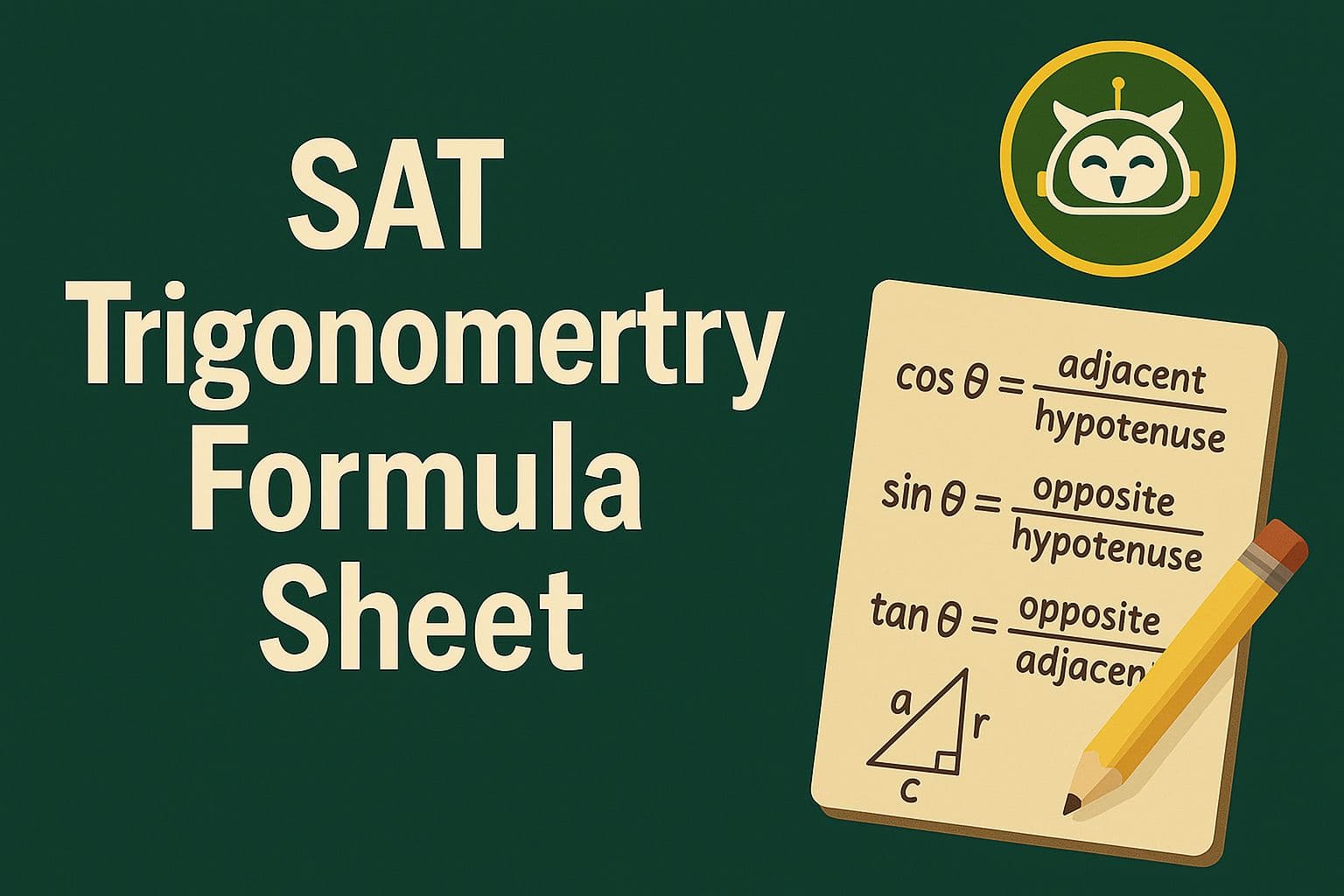
Want to ace SAT trigonometry? Here's everything you need to know - fast. Trigonometry questions on the SAT focus on SOHCAHTOA, special right triangles (30-60-90 and 45-45-90), and key formulas like the Pythagorean theorem. Memorizing side ratios, understanding complementary angles, and practicing inverse trig functions can save you time and boost accuracy.
Key Takeaways:
- SOHCAHTOA Basics: Sine = Opposite/Hypotenuse, Cosine = Adjacent/Hypotenuse, Tangent = Opposite/Adjacent.
- Special Triangles:
- 45-45-90: Legs = x, Hypotenuse = x√2.
- 30-60-90: Shortest leg = x, Longer leg = x√3, Hypotenuse = 2x.
- Pythagorean Theorem: a² + b² = c² for right triangles.
- Pythagorean Identity: sin²(θ) + cos²(θ) = 1.
- Angle Conversions: Degrees ↔ Radians using π/180.
Quick Tips:
- Draw diagrams: Label sides, angles, and known values.
- Use the right formula: Match the problem type to SOHCAHTOA or special triangle rules.
- Avoid mistakes: Check your calculator mode (degrees, not radians) and simplify answers.
Master these basics, and you'll be ready to tackle any trigonometry problem on the SAT with confidence.
Where does your SAT plateau hit?
6 questions, ~3 minutes. We'll show you exactly where you transition from getting things right to getting them wrong — your real SAT plateau, not just a number.
ALL Trigonometry on the SAT!
Basic Trigonometry Concepts
Understanding these key trigonometry principles can help you succeed on the SAT Math section. Let’s break down the essential concepts and formulas.
SOHCAHTOA: The Key Ratios
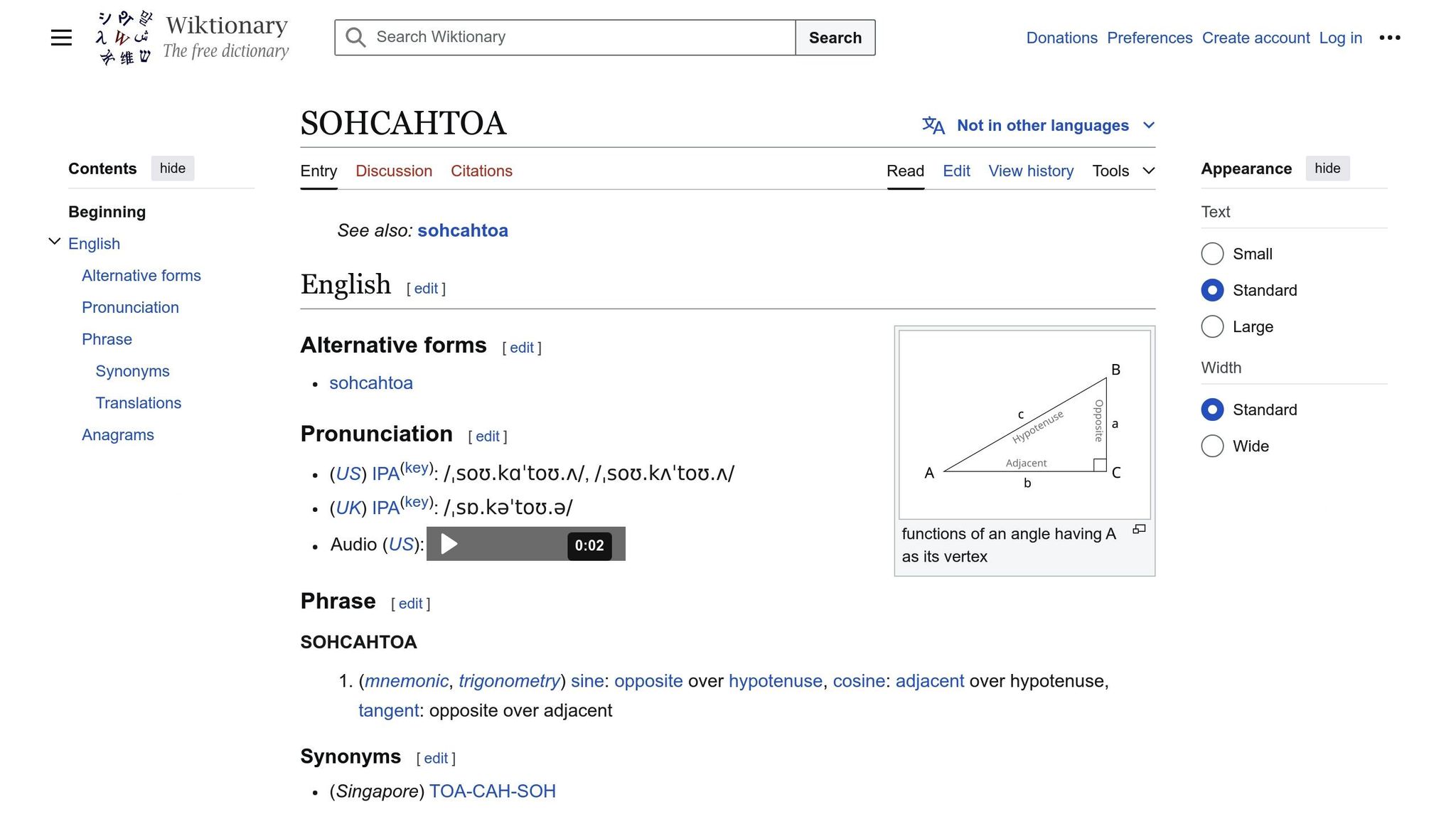
SOHCAHTOA is a handy way to remember the three main trigonometric ratios for right triangles:
| Ratio | Formula | Mnemonic |
|---|---|---|
| Sine (sin) | Opposite/Hypotenuse | SOH |
| Cosine (cos) | Adjacent/Hypotenuse | CAH |
| Tangent (tan) | Opposite/Adjacent | TOA |
In a right triangle, these ratios depend on the angle you're working with. The opposite side is directly across from the angle, the adjacent side is next to it, and the hypotenuse is always the longest side.
Common Right Triangles: 30-60-90 and 45-45-90
Certain right triangles with fixed ratios show up often on the SAT:
45-45-90 Triangle:
- Both legs are the same length.
- If each leg is x, the hypotenuse is x√2.
- The two non-right angles are both 45°.
30-60-90 Triangle:
- The shortest leg (opposite 30°) is x.
- The hypotenuse is 2x.
- The longer leg (opposite 60°) is x√3.
Complementary Angles and the Pythagorean Theorem
Complementary angles (two angles that add up to 90°) have specific trigonometric relationships:
- sin(x) = cos(90° - x)
- cos(x) = sin(90° - x)
- tan(x) = 1/tan(90° - x)
The Pythagorean theorem (a² + b² = c²) is essential for calculating missing sides, verifying right triangles, or solving distance problems.
sbb-itb-a0f4a21
Predict your SAT score in 5 minutes
Answer 10 adaptive questions across all 8 SAT domains. We'll predict your composite score, identify your strongest and weakest areas, and match you to colleges where you fit.
Main Trigonometry Formulas for the SAT
Knowing these formulas can make solving trigonometry problems on the SAT much easier. Practice applying them to save time and boost your confidence during the test.
Using Sine, Cosine, and Tangent
For right triangles, these relationships are essential for finding missing sides:
| To Find | Formula | When to Use |
|---|---|---|
| Opposite Side | sin(θ) × hypotenuse | When you know the angle and hypotenuse |
| Adjacent Side | cos(θ) × hypotenuse | When you know the angle and hypotenuse |
| Hypotenuse | opposite ÷ sin(θ) | When you know the angle and opposite side |
To calculate angles, use the inverse functions:
- θ = sin⁻¹(opposite/hypotenuse)
- θ = cos⁻¹(adjacent/hypotenuse)
- θ = tan⁻¹(opposite/adjacent)
These formulas allow you to quickly solve for unknown sides and angles, which is especially helpful under time pressure. Next, let’s see how these ratios work with special triangles.
Working with Special Triangles
The 45-45-90 and 30-60-90 triangles are key for many SAT problems. These triangles have specific side ratios that you should memorize. Combine these with other trigonometric relationships, like the Pythagorean identity and angle conversion formulas, to handle a variety of questions.
Pythagorean Identity and Angle Conversions
The Pythagorean Identity is a useful tool for verifying calculations or finding missing values:
- sin²(θ) + cos²(θ) = 1
For converting angles between degrees and radians:
- Degrees to radians: Multiply by π/180
- Radians to degrees: Multiply by 180/π
Here are some commonly tested angle values:
| Angle in Degrees | Angle in Radians |
|---|---|
| 30° | π/6 |
| 45° | π/4 |
| 60° | π/3 |
| 90° | π/2 |
While the SAT provides some formulas, knowing these by heart will save you time and reduce errors. Practice with different triangle setups to get comfortable applying these concepts quickly and accurately.
Problem-Solving Methods for SAT Trigonometry
To ace trigonometry on the SAT, you’ll need both a solid understanding of the concepts and a smart approach to solving problems. Below are some effective methods to help you tackle these questions with confidence.
Drawing and Reading Triangle Diagrams
Clear and accurate diagrams are key to solving trigonometry problems efficiently.
| Diagram Element | Best Practice | Why It Matters |
|---|---|---|
| Angle Labels | Use Greek letters or numbers | Makes angles easier to identify |
| Side Labels | Use lowercase letters (a, b, c) | Helps with using formulas |
| Known Values | Mark with solid lines | Highlights given information |
| Right Angles | Add a square corner symbol | Confirms when to apply SOHCAHTOA |
Start by identifying the type of triangle you're working with - right, special right (like 30-60-90 or 45-45-90), or oblique. Be extra careful with problems involving angles of elevation or depression, as these often require a clear setup before solving.
Once your diagram is ready, use it as a guide to solve the problem step by step.
Step-by-Step Problem Solutions
A clear diagram is your first step toward solving trigonometry problems systematically. Here’s how to approach them:
1. Determine the Triangle Type
Quickly figure out if it’s a 30-60-90, 45-45-90, or a regular right triangle.
2. Label All Known Values
Write down every given measurement and angle directly on your diagram.
3. Pick the Right Formula
Choose the formula that matches what you’re solving for:
- Use SOHCAHTOA ratios for missing sides.
- Apply inverse trig functions for unknown angles.
- Use standard ratio relationships for special triangles.
By following this structured process, you’ll stay organized and avoid unnecessary mistakes.
Common Trigonometry Mistakes to Avoid
Avoiding common errors can save you time and points. Here’s how to steer clear of the most frequent pitfalls:
| Common Mistake | How to Avoid It |
|---|---|
| Using the wrong trig ratio | Double-check which sides are opposite and adjacent. |
| Calculator in the wrong mode | Make sure it’s set to degrees, not radians. |
| Misidentifying special triangles | Confirm the angle measures before applying ratios. |
| Skipping simplification | Check if your final answer can be reduced. |
| Inverse function confusion | Remember that sin⁻¹(sin(x)) ≠ x for all values. |
Pay extra attention to problems involving angles of elevation and depression - they’re common on the SAT and require precise diagram interpretation. The more familiar you are with these patterns, the faster and more accurate you’ll be.
Conclusion: Practice Tips for SAT Trigonometry
Mastering SAT trigonometry takes consistent, focused practice. Here are some practical strategies to help you improve:
1. Start with the Basics
Learn SOHCAHTOA and special triangles first. These are the building blocks for more advanced problems. Use practice tests to pinpoint and work on weak areas.
2. Build Step by Step
Work through topics in order, ensuring you fully understand each one before moving on. This prevents gaps in your knowledge that could hurt your performance.
3. Focus on Weak Spots
Spend extra time on areas where you struggle. Regular, targeted practice with customized materials can help you strengthen specific skills.
Consistent practice with immediate feedback is key. Use tools like adaptive drills to focus on weak areas while improving your overall understanding.
| Practice Component | Purpose | Benefit |
|---|---|---|
| Adaptive Drills | Match your skill level | Quicker mastery of concepts |
| Topic-Specific Tests | Focus on certain areas | Improve targeted skills |
| Full-Length Mock Tests | Simulate real exam settings | Build stamina and confidence |
Take it one concept at a time, and revisit the fundamentals as needed. With a strategic and disciplined approach, you'll be ready to tackle any trigonometry question on the SAT.
What kind of mistakes are costing you points?
7 questions, ~3 minutes. After each, tell us what happened — we'll surface the *pattern* that's keeping your score down (it's almost never knowledge).