The 7 right-triangle patterns most tested on the digital SAT are: the Pythagorean theorem and Pythagorean triples (3-4-5, 5-12-13, 7-24-25, 8-15-17), 45-45-90 and 30-60-90 special triangles, SOH-CAH-TOA trig ratios, complementary-angle identities (sin(x°) = cos(90 − x°)), angle-sum rules for triangles and quadrilaterals, perimeter and side-ratio problems, and Desmos shortcuts using polygon and distance functions.
Right triangles trip up more SAT test-takers than almost any other geometry topic — not because the concepts are hard, but because there are four distinct question types hiding under one label, and most students only prepare for one of them. A single 30-minute session with the right framework changes that completely.
The good news: once you lock in the Pythagorean theorem, the three special triangle ratios, and a handful of trig rules, you'll recognize every right-triangle question on sight — and Desmos can handle the heavy arithmetic in seconds. This guide breaks down the 7 core techniques you need, with real worked examples drawn straight from the SAT question bank, so you know exactly what to expect on test day.
Whether you're starting from scratch or just trying to squeeze out those last few points in the Geometry and Trigonometry domain, this is the playbook.
- The Pythagorean Theorem & Pythagorean Triples
- 45-45-90 and 30-60-90 Special Triangles
- SOH-CAH-TOA — Setting Up Trig Ratios
- Complementary Angles & Key Trig Identities
- Angle-Sum Rules: Triangles & Quadrilaterals
- Perimeter, Ratio, and Missing-Side Questions
- Desmos Shortcuts for Right-Triangle Questions
Where does your SAT plateau hit?
6 questions, ~3 minutes. We'll show you exactly where you transition from getting things right to getting them wrong — your real SAT plateau, not just a number.
1. The Pythagorean Theorem & Pythagorean Triples
Typical Question: "In the given right triangle, if m = 7 and n = 24, what is the length of the hypotenuse?"
🧠 Traditional Way:
Most students write out a² + b² = c², square each leg, add them, then take the square root. That works perfectly — but it's slow when the arithmetic is messy, and it's easy to forget which side is the hypotenuse under time pressure.
❌ Common Pitfalls:
- Squaring the hypotenuse instead of the legs (putting c² on the wrong side).
- Forgetting to take the square root at the end and choosing the c² value as the answer.
- Not recognizing a Pythagorean triple — wasting 60 seconds on arithmetic you didn't need.
- Mislabeling which side is the hypotenuse (it's always opposite the right angle).
✅ The Smarter Approach:
Memorize the five most-tested Pythagorean triples cold. If the two given legs match a triple, write the answer in five seconds without any calculation.
| Triple | Legs | Hypotenuse | Common SAT Multiples |
|---|---|---|---|
| 3-4-5 | 3, 4 | 5 | 6-8-10, 9-12-15 |
| 5-12-13 | 5, 12 | 13 | 10-24-26 |
| 7-24-25 | 7, 24 | 25 | 14-48-50 |
| 8-15-17 | 8, 15 | 17 | 16-30-34 |
| 20-21-29 | 20, 21 | 29 | rarely scaled |
Worked Example (Easy)
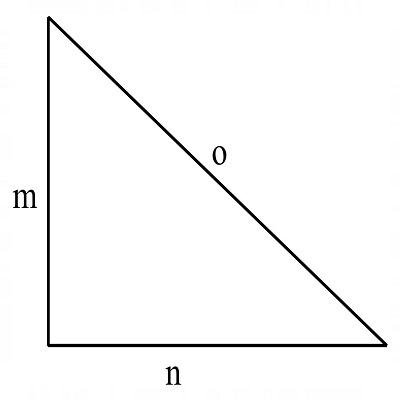
Question: In the given right triangle, if m = 7 and n = 24, what expression represents the length of o?
- A) 7√24
- B) 32
- C) 28
- D) 25
Solution: Spot the triple immediately — 7 and 24 are two legs of the classic 7-24-25 triple. The hypotenuse o = 25. You can verify with the Pythagorean theorem: 7² + 24² = 49 + 576 = 625, and √625 = 25. Answer: D. If you didn't recognize the triple, you'd still arrive at 25 via algebra — but knowing your triples cold turns a 90-second problem into a 10-second one.
Pro Tip: When you see legs of 5 and 12, or 7 and 24, pause before computing anything. The SAT uses these exact triples repeatedly. If the legs match — or are multiples — write the hypotenuse immediately.
Worked Example (Hard)
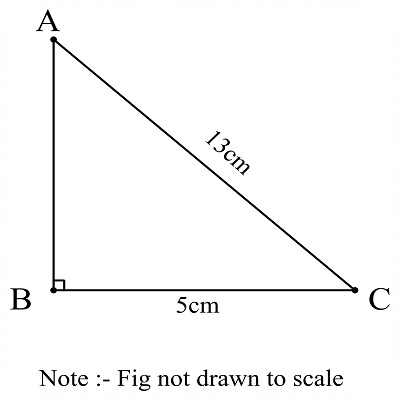
Question: In a right angled triangle ABC, ∠B = 90°. If AC = 13 cm, BC = 5 cm, find AB.
- A) 6 cm
- B) 8 cm
- C) 10 cm
- D) 12 cm
Solution: AC is the hypotenuse (opposite the right angle at B), BC = 5 is one leg, AB is unknown. Recognize the 5-12-13 triple: if the hypotenuse is 13 and one leg is 5, the other leg is 12. Verify: 5² + 12² = 25 + 144 = 169 = 13². Answer: D. The classic mistake here is treating AB as the hypotenuse — always confirm which side is opposite the right angle before applying the theorem.
2. 45-45-90 and 30-60-90 Special Triangles
Typical Question: "An equilateral triangle has a side length of 10. What is its height?"
🧠 Traditional Way:
Students set up the Pythagorean theorem from scratch, solve for the unknown side, then simplify the radical. This is correct but slow, especially when the SAT disguises a special triangle inside a larger figure.
❌ Common Pitfalls:
- Mixing up the two special triangle ratios (which angle gets the x√3 side?).
- Forgetting that the hypotenuse is always the longest side — it's 2x in a 30-60-90, not x.
- Not recognizing that a square cut diagonally produces two 45-45-90 triangles.
- Using the ratios in the wrong direction (multiplying instead of dividing when the hypotenuse is given).
✅ The Smarter Approach:
Stamp these two ratio templates into memory. Whenever you see an isosceles right triangle or an equilateral triangle cut in half, reach for the template before doing any algebra.
| Triangle Type | Angles | Short Leg | Long Leg | Hypotenuse |
|---|---|---|---|---|
| 45-45-90 | 45°, 45°, 90° | x | x | x√2 |
| 30-60-90 | 30°, 60°, 90° | x | x√3 | 2x |
On the digital SAT, the reference sheet at the start of each math module shows these ratios — but flipping back and forth wastes 20–30 seconds per question. Memorize them before test day so you never need the reference sheet at all.
Pro Tip: For the 30-60-90 triangle, the mnemonic "Short side, Short × √3, Short × 2" keeps the three sides in order. Always identify the 30° angle first — its opposite side is the short leg x, and everything else scales from there.
3. SOH-CAH-TOA — Setting Up Trig Ratios
Typical Question: "In right triangle PQR, ∠R = 90°. If PQ = 17 and QR = 8, what is sin(P)?"
🧠 Traditional Way:
Label the sides as opposite, adjacent, and hypotenuse relative to the reference angle, then plug into the correct ratio. The process is straightforward in isolation but breaks down fast when the diagram is rotated or the angle is labeled unexpectedly.
❌ Common Pitfalls:
- Labeling "opposite" and "adjacent" relative to the right angle instead of the reference angle.
- Confusing sin and cos when the triangle is drawn in an unusual orientation.
- Using a decimal approximation when the SAT wants an exact fraction.
- Forgetting that the hypotenuse is always opposite the 90° angle — not opposite the reference angle.
✅ The Smarter Approach:
Lock in SOH-CAH-TOA with a concrete labeling routine:
- Circle the reference angle (not the right angle).
- Label the side directly across from it: Opposite.
- Label the side touching it (that isn't the hypotenuse): Adjacent.
- Label the longest side: Hypotenuse.
- Apply: sin = O/H, cos = A/H, tan = O/A.
| Function | Ratio | Memory hook |
|---|---|---|
| sin(θ) | Opposite / Hypotenuse | Some Old Hippos |
| cos(θ) | Adjacent / Hypotenuse | Can Always Hide |
| tan(θ) | Opposite / Adjacent | Their Old Age |
The SAT also tests the complementary angle identity heavily: sin(θ) = cos(90° − θ). If the question gives you sin(32°) and asks for cos(58°), the answer is identical — no calculation needed. This comes up in roughly one question per math module, so it's worth about 10 points of familiarity.
Pro Tip: When the question gives you two sides and asks for a trig ratio, you often don't need to find the angle at all. Sin(P) = opposite/hypotenuse is a ratio, not an angle — just plug in the side lengths directly. Reaching for the inverse trig function is a common trap that wastes 30 seconds.
4. Complementary Angles & Key Trig Identities
Typical Question: "If cos(x°) = 3/5 and x + y = 90, what is sin(y°)?"
🧠 Traditional Way:
Students try to find the angle x using inverse cosine, then compute y = 90 − x, then compute sin(y). Three steps, each with potential rounding error.
❌ Common Pitfalls:
- Using a calculator in radian mode when the question is in degrees (this is the #1 trig mistake on the digital SAT — see below).
- Working out the full three-step chain when a one-step identity solves it.
- Confusing sin²(θ) + cos²(θ) = 1 with other algebraic rearrangements.
- Forgetting that tan(θ) = sin(θ)/cos(θ) when you need to connect two given pieces of information.
✅ The Smarter Approach:
Three identities cover almost every SAT trig identity question:
- Complementary identity: sin(θ) = cos(90° − θ) and cos(θ) = sin(90° − θ)
- Pythagorean identity: sin²(θ) + cos²(θ) = 1
- Ratio identity: tan(θ) = sin(θ) / cos(θ)
For the example above: since x + y = 90, y = 90 − x. So sin(y°) = sin(90° − x°) = cos(x°) = 3/5. One step. Done.
On Desmos: if you need to verify a trig value, first confirm degree mode by checking that sin(30) = 0.5. If it returns −0.988, you're in radian mode — click the wrench icon (top-right of the graph) and toggle to Degrees immediately.
5. Angle-Sum Rules: Triangles & Quadrilaterals
Typical Question: "In quadrilateral WXYZ, ∠W = 90°, ∠X = 90°, ∠Z = 50°. What is ∠XYZ?"
🧠 Traditional Way:
Add up the known angles and subtract from the total. Students sometimes hesitate because they forget the total for quadrilaterals vs. triangles, or they confuse interior angles with exterior angles.
❌ Common Pitfalls:
- Using 180° as the total for a quadrilateral (it's 360°).
- Confusing the exterior angle theorem: the exterior angle equals the sum of the two non-adjacent interior angles.
- Assuming a figure is a rectangle or parallelogram without being told so.
- Missing that a right-angle mark in the diagram means exactly 90° — not approximately.
✅ The Smarter Approach:
The angle-sum rules are simple and non-negotiable:
- Triangle: interior angles sum to 180°
- Quadrilateral: interior angles sum to 360°
- Any polygon with n sides: interior angles sum to (n − 2) × 180°
- Exterior angle theorem: exterior angle = sum of the two non-adjacent interior angles
Worked Example (Medium)
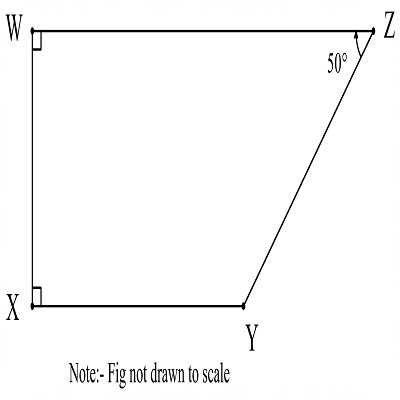
Question: In the quadrilateral presented, what is the measure of ∠XYZ?
- A) 98°
- B) 100°
- C) 112°
- D) 130°
Solution: In quadrilateral WXYZ, ∠W and ∠X are each 90°, and ∠Z = 50°. The four interior angles must sum to 360°. So: ∠XYZ = 360° − (90° + 90° + 50°) = 360° − 230° = 130°. Answer: D. The most common mistake is subtracting from 180° — remember, triangles use 180°, quadrilaterals use 360°.
Pro Tip: When a figure has right-angle marks at two vertices and you're asked for a third, that's almost always a 360° subtraction problem. Mark the known angles directly on your scratch paper (or the embedded figure tool) before writing any equation — it prevents the 180° vs. 360° mix-up.
Predict your SAT score in 5 minutes
Answer 10 adaptive questions across all 8 SAT domains. We'll predict your composite score, identify your strongest and weakest areas, and match you to colleges where you fit.
6. Perimeter, Ratio, and Missing-Side Questions
Typical Question: "The sides of a rectangle are in the ratio 4:5. If the perimeter is 90 cm, find both side lengths."
🧠 Traditional Way:
Set up variables, write the perimeter equation, solve. This works, but students frequently stumble on the ratio step — assigning the same variable to both sides instead of using the multiplier correctly.
❌ Common Pitfalls:
- Setting l = 4 and b = 5 directly, then plugging into the perimeter formula — this ignores the multiplier and always gives the wrong answer.
- Forgetting that rectangle perimeter is 2(l + b), not l + b.
- Solving for x but forgetting to multiply back (x gives the unit; the actual sides are 4x and 5x).
- Not checking that the two final sides actually sum to the correct perimeter.
✅ The Smarter Approach:
For any ratio problem: let the sides be kx and mx where k:m is the given ratio, then solve for x and scale up.
Worked Example (Hard)
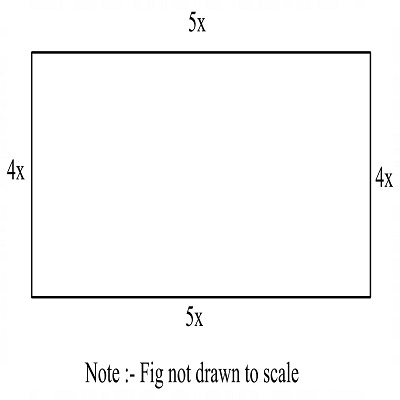
Question: The sides of a rectangle are in the ratio of 4:5. If the perimeter of the rectangle is 90 cm, find its sides.
- A) l = 10 cm, b = 12 cm
- B) l = 15 cm, b = 30 cm
- C) l = 20 cm, b = 35 cm
- D) l = 25 cm, b = 20 cm
Solution: Let the length = 5x and the breadth = 4x (assign the larger ratio value to the longer side). Perimeter: 2(5x + 4x) = 90 → 2(9x) = 90 → 18x = 90 → x = 5. Therefore l = 5(5) = 25 cm and b = 4(5) = 20 cm. Check: 2(25 + 20) = 90 ✓. Answer: D.
Worked Example (Easy)
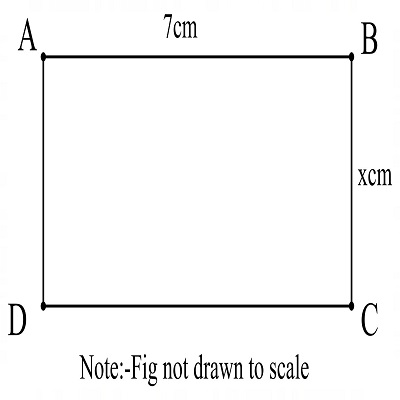
Question: The perimeter of the given figure is 32 cm. Find the length of the missing side.
- A) 8 cm
- B) 9 cm
- C) 13 cm
- D) 15 cm
Solution: Using the rectangle perimeter formula: 2(l + b) = 32, and l = 7 cm. So 2(7 + b) = 32 → 14 + 2b = 32 → 2b = 18 → b = 9 cm. Answer: B. If you guessed 8 because it "looks close" on the diagram — that's exactly the kind of estimate the SAT punishes. Always set up the equation.
7. Desmos Shortcuts for Right-Triangle Questions
Typical Question: Any right-triangle problem where you need to evaluate a trig ratio, find a missing side, or verify equivalent expressions.
🧠 Traditional Way:
Work through each step by hand — square the legs, take the square root, reduce the radical, then check arithmetic. For trig, recall the ratio, set up the fraction, and simplify. Each step is a new opportunity for error.
❌ Common Pitfalls:
- Using Desmos in radian mode for degree-based trig questions — sin(30) returning −0.988 instead of 0.5.
- Trying to use Desmos for algebraic factoring or simplification — it can't do that.
- Typing the distance formula manually instead of using the built-in
distance()function. - Not clicking grey dots — estimating intersection or zero coordinates from the graph instead of reading exact values.
✅ Desmos Shortcuts That Actually Work:
1. Check your Pythagorean theorem arithmetic instantly. Type sqrt(7^2 + 24^2) directly into Desmos. It returns 25. No pencil, no error.
2. Use the distance function for side lengths. If two vertices are given as coordinates, type distance((0,0),(7,24)) and Desmos returns the exact side length. Skip the formula entirely.
3. Verify trig values in degree mode. Switch to degree mode (wrench icon → Degrees), then type sin(30) — you should get 0.5. If you see −0.988, you're in radian mode. Fix it before every trig question. Quick check: sin(30) = 0.5 means you're good to go.
4. Evaluate trig expressions without finding the angle. Define the triangle's sides, then type the ratio directly. For example, if the opposite side is 5 and the hypotenuse is 13, type 5/13 to get the decimal equivalent of sin — then match it to the answer choices.
5. Back-solve with a table when answer choices are given. Open a table (Ctrl+Alt+T), enter the four answer-choice values in the x₁ column, replace the y₁ header with your expression (e.g., 2*x_1^2 - x_1), and the correct answer jumps out. This is especially powerful on ratio and perimeter questions where all four choices are numbers.
Pro Tip: For trig questions, always type
sin(30)as your very first Desmos action on a new question. If the answer isn't 0.5, switch to degree mode before doing anything else. This 3-second check has saved countless test-takers from a wrong answer on what should have been an easy question.
For a full breakdown of every Desmos technique available on the digital SAT — from regression to sliders to function composition — see The Ultimate Desmos Cheat Sheet for SAT 2026. And if circles are giving you trouble alongside triangles, SAT Circles Made Easy covers every circle geometry shortcut in the same format.
Right Triangles & Trig: Quick-Reference Summary
| Concept | Key Formula / Rule | Desmos Shortcut? | Frequency on SAT |
|---|---|---|---|
| Pythagorean theorem | a² + b² = c² | sqrt(a^2 + b^2) | Very high |
| Pythagorean triples | 3-4-5, 5-12-13, 7-24-25, 8-15-17 | Recognize instantly | High |
| 45-45-90 triangle | x : x : x√2 | No — memorize | Medium |
| 30-60-90 triangle | x : x√3 : 2x | No — memorize | Medium |
| sin / cos / tan | SOH-CAH-TOA | Degree mode check | High |
| Complementary identity | sin(θ) = cos(90°−θ) | No — one step | Medium |
| Triangle angle sum | 180° | No — arithmetic | High |
| Quadrilateral angle sum | 360° | No — arithmetic | Medium |
| Perimeter + ratio | Let sides = kx, mx; solve | Table back-solve | Medium |
If you're also working on the broader geometry domain, check out our 7 Strategies for the Problem-Solving & Data Analysis domain and the SAT Quadratic & Parabola Cheat Sheet — both feed directly into the same math module right-triangle questions appear in. For test-date planning, the full SAT calendar has every 2026 window.
Final Thoughts: Right Triangles Are a Reliable Score Booster
Right triangles and trigonometry are genuinely one of the most learnable corners of SAT math. Unlike some algebra topics that require deep fluency, the triangle rules are finite: five Pythagorean triples, two special triangle ratios, three trig functions, and three core identities. Get those locked in and you've covered the vast majority of what the SAT can ask. The worked examples in this guide — drawn directly from the question bank — show exactly how those rules appear in practice, not in theory.
The Desmos shortcuts in section 7 are the multiplier. They don't replace understanding the math; they eliminate arithmetic errors and save you 30–60 seconds per question. That's time you can redirect to the harder questions in each module. Start with the degree-mode check habit on every trig question, and the distance/sqrt shortcuts for hypotenuse calculations, and you'll notice the difference immediately.
Your next move: run through the worked examples above without looking at the solutions, then use the 7 Most Common SAT Math Mistakes guide to audit which errors you still make under time pressure. Pattern recognition plus error elimination — that's the complete triangle playbook.
Frequently Asked Questions
What right triangle topics appear most on the digital SAT?
The digital SAT tests right triangles through five recurring patterns: the Pythagorean theorem and triples (3-4-5, 5-12-13, 7-24-25, 8-15-17), the 45-45-90 and 30-60-90 special triangles, SOH-CAH-TOA trig ratios, complementary-angle identities (sin(x°) = cos(90-x°)), and angle-sum rules in triangles and quadrilaterals. Recognising these patterns lets you sight-read most right-triangle problems in under 30 seconds.
What are the most common Pythagorean triples on the SAT?
The four Pythagorean triples that show up most on the digital SAT are 3-4-5, 5-12-13, 7-24-25, and 8-15-17. The College Board also scales these by 2× and 3× — so 6-8-10, 9-12-15, 10-24-26, and 14-48-50 are common too. Memorising the base triples lets you skip the Pythagorean computation entirely on these problems.
How do you handle 30-60-90 and 45-45-90 triangles on the SAT?
For a 30-60-90 triangle, the side ratios are 1 : √3 : 2 (short leg : long leg : hypotenuse). For a 45-45-90 triangle, the ratios are 1 : 1 : √2 (leg : leg : hypotenuse). Memorise these two ratios — most SAT special-triangle questions need only one ratio multiplication or division to solve.
What's the fastest way to solve SAT trig ratio questions?
Use SOH-CAH-TOA: sin(θ) = opposite/hypotenuse, cos(θ) = adjacent/hypotenuse, tan(θ) = opposite/adjacent. For complementary-angle SAT questions where x + y = 90, apply the identity sin(x°) = cos(y°). This identity solves "if cos(x°) = 3/5 and x + y = 90, find sin(y°)" in one step — no inverse trig needed.
Should I use Desmos for right-triangle SAT questions?
Use Desmos for distance and trig verification, not for setting up the geometry. Type distance((x_1, y_1), (x_2, y_2)) to compute exact side lengths without Pythagorean setup. For trig values, always type sin(angle · π/180) to ensure degree mode regardless of Desmos calculator state. Skip Desmos for ratio and angle-sum problems — they're faster mentally.
Related guides
- How to Solve Linear Equation Word Problems on the SAT
- 7 Strategies for Excelling in Problem-Solving and Data Analysis domain on the SA
- SAT Geometry Reloaded: Circles, Angles & Coordinates
- SAT Math-Anxious? 7 Micro-Habits That Raised Scores 110 Points in 30 Days
- 5-Minute Micro-Lessons vs 45-Minute Lectures: Which Boosts SAT Math Faster?
What kind of mistakes are costing you points?
7 questions, ~3 minutes. After each, tell us what happened — we'll surface the *pattern* that's keeping your score down (it's almost never knowledge).