
Feeling overwhelmed by SAT prep? Here’s how to simplify it:
- Step 1: Take a Practice Test – Use official SAT practice tests to find your strengths and weaknesses.
- Step 2: Analyze Your Results – Break down your mistakes: Are they from concepts you don’t know, careless errors, or time pressure?
- Step 3: Prioritize Your Focus – Choose 2–3 areas where improvement will boost your score the most.
- Step 4: Create a Weekly Plan – Dedicate 60% of your study time to your weakest section and 40% to your stronger one.
- Step 5: Use Study Tools – Track your progress with tools like Pursu’s AI Study Director and adaptive tests.
Where does your SAT plateau hit?
6 questions, ~3 minutes. We'll show you exactly where you transition from getting things right to getting them wrong — your real SAT plateau, not just a number.
Step 1: Measure Your Current Level
Take a Practice Test
Set aside 3 hours and recreate test-day conditions by using College Board's Bluebook digital practice tests. Complete all four sections in one uninterrupted sitting.
Analyze Your Scores
Look over your score report carefully. Pay attention to:
- Your total score (out of 1600)
- Scores for the Evidence-Based Reading and Writing (ERW) and Math sections
- A detailed breakdown of your performance on individual questions
Search for patterns in your results. Are there specific concepts you’re struggling with? Are you making careless mistakes? Do you tend to make more errors toward the end of each section due to time pressure? Take note of any strategies that seem inefficient.
Track Your Results
Create a log for each practice test. Include details like:
- The test date
- Total score and section scores
- Topics you need to review
- How you managed your time for each section
- Types of questions you found challenging
- Repeated mistakes or errors
Once you’ve established this baseline, you’ll be ready to move on to Step 2, where you’ll pinpoint your strengths and areas for improvement.
Step 2: List Strong and Weak Points
Review Each Test Section
Using your test log from Step 1, take a close look at your performance in each section. Identify where you lost points and break down your strengths and weaknesses.
Here’s how to organize your review by section and topic:
| Section | Key Categories |
|---|---|
| Reading & Writing | Command of Evidence; Words in Context; Expression of Ideas; Standard English Conventions; Analysis in History/Social Studies; Analysis in Science |
| Math | Algebra & Functions; Problem Solving & Data Analysis; Advanced Math; Geometry & Trigonometry |
Next, classify your mistakes into these categories:
- Conceptual Errors: Misunderstanding key ideas or concepts
- Careless Mistakes: Simple slip-ups, like misreading or calculation errors
- Time Pressure Errors: Mistakes made when rushing due to time constraints
- Strategy Gaps: Using methods that aren’t effective or efficient
Prioritize Topics That Can Boost Your Score
Focus on areas where you can make the biggest improvements. Choose two or three categories from the table where your accuracy is currently the lowest. Set specific, measurable goals to track your progress - for example, improving your Algebra accuracy from 60% to 80% within three weeks.
Step 3: Choose Your Main Focus
Key Factors
Now that you've listed your strengths and weaknesses, it's time to decide which section - Reading & Writing or Math - should get most of your attention. To make this choice, consider these three factors:
- Target Score Requirements: What are the score expectations for your target schools?
- Performance Gap: Which section has a lower score compared to the other?
- Study Time Available: How much time do you have left to prepare before test day?
Decision Chart
This chart can help you figure out where to focus your efforts:
| Factor | Focus on Math If… | Focus on Reading & Writing If… |
|---|---|---|
| Section Score Gap | Your Math score is lower than your Reading & Writing score | Your Reading & Writing score is lower than your Math score |
| Error Patterns | You struggle with concepts or strategies in Math | You often make careless mistakes or feel rushed in Reading & Writing |
| Available Study Time | You don’t have much time left to prepare | You have plenty of time to dedicate to studying |
Time Allocation Guidelines
Plan to dedicate about 60% of your weekly study time to your primary focus area and the remaining 40% to the other section. For example, if you’re studying for 10 hours a week, spend 6 hours on your main focus and 4 hours on the other. Use the section timing table from the Introduction to help pace your practice sessions.
Once you’ve decided on your main focus, move on to Step 4 to create your week-by-week study plan.
sbb-itb-a0f4a21
Predict your SAT score in 5 minutes
Answer 10 adaptive questions across all 8 SAT domains. We'll predict your composite score, identify your strongest and weakest areas, and match you to colleges where you fit.
SAT Study Plan - Overview of the 10 Steps
Step 4: Create Your Weekly Plan
Organize your study sessions around the areas you need to focus on.
Plan Your Study Hours
Set aside regular, consistent study times:
- Choose specific days and dedicate 2–3-hour blocks for studying.
- Balance your time between reviewing concepts, practicing problems, and taking occasional full-length tests.
- Spend extra time working on the skills or topics you struggle with the most.
Once your schedule is set, establish benchmarks to track your progress. Use these during the Monitor and Update phase.
Monitor and Update
Keep track of your progress using Pursu's AI Study Director and your personal log. Focus on:
- Scores from practice tests in each section.
- Time spent on different types of questions.
- Patterns in errors and areas where improvement is needed.
- Weekly goals and whether they were met.
Every two weeks, take a full-length test. If your scores are improving, stick with your plan. If they level off, focus more on weaker areas. If they drop, revisit the basics to strengthen your foundation.
Step 5: Set Up Your Study Tools
Once you've established your weekly goals in Step 4, it's time to use tools that can help keep you organized and provide automatic feedback.
Pursu Tools
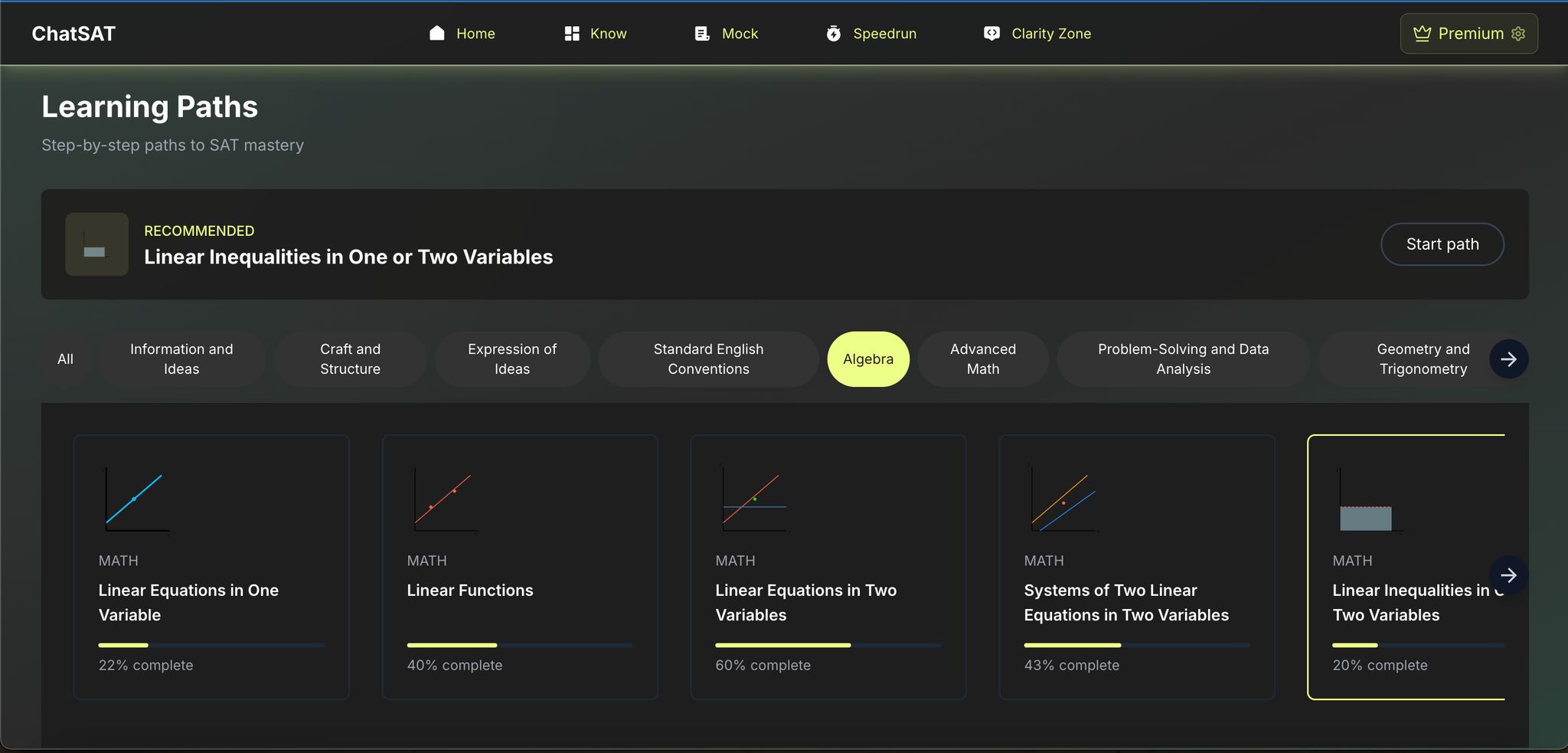
- AI Study Director: Link Pursu's AI Study Director to your account. It reviews your practice data in real time and identifies areas where you can improve your scores.
- Adaptive Tests: Set up tests that adjust their difficulty based on your progress, ensuring you're always challenged at the right level.
Finally, download the study tracker template to automatically record your sessions and track your results.
Wrapping Up
Once you've completed these five steps, it's time to put your plan into motion. By following a structured approach - evaluating your current skills, identifying areas to improve, choosing a focus, creating a weekly schedule, and organizing your tools - you can tackle SAT prep with confidence and clarity.
Pursu's AI Study Director and real-time practice tools make it easier to stay on track. With personalized feedback, you can fine-tune your strategy and make the most of every study session, bringing you closer to your goal score.
Here’s what to do next:
- Take an initial practice test to determine your starting point.
- Use Pursu's AI Study Director to create your customized study plan.
- Set achievable weekly study goals that match your target score.
- Monitor your progress with Pursu's downloadable study template.
What kind of mistakes are costing you points?
7 questions, ~3 minutes. After each, tell us what happened — we'll surface the *pattern* that's keeping your score down (it's almost never knowledge).
Related guides
- Parents’ Guide to the Digital SAT: How to Support Your Teen Without Adding Stres
- This 1 Change in Reviewing Your SAT Mistakes Could Boost 150 points Faster
- Interleaved Practice: The Week-4 Switch That Powers 60-Point SAT Jumps
- Double-Stacking Exams: Should You Sit for Both ACT and SAT in the Same Season?
- SAT Cross-Text Connections Decoding: A 3‑Step Evidence Pair Method